


Competitive regimes: the five cluster model.
Any developed economy is not a monolith, but a collection of qualitatively different markets, each with its own internal logic, dynamics, and rules of the game. To navigate this complex environment and develop effective strategies, it is critical to move from analyzing individual industries to understanding their systemic grouping—clustering.
The proposed model identifies five fundamental types of industry markets based on a triad of key parameters: market scale (turnover), number of players, and competitive density. This clustering reveals profound differences in the structure and functioning of sectors, determining not only the level of competition but also the nature of entry barriers, the type of dominant players, and the potential for consolidation or growth.
Understanding which of the five clusters your market belongs to provides a strategic advantage, allowing you to:
- accurately assess the intensity and nature of competitive pressure;
- forecast market dynamics and inflection points;
- formulate realistic strategic goals consistent with the cluster's structural capabilities;
- identify potential expansion vectors into adjacent segments with similar market logic.
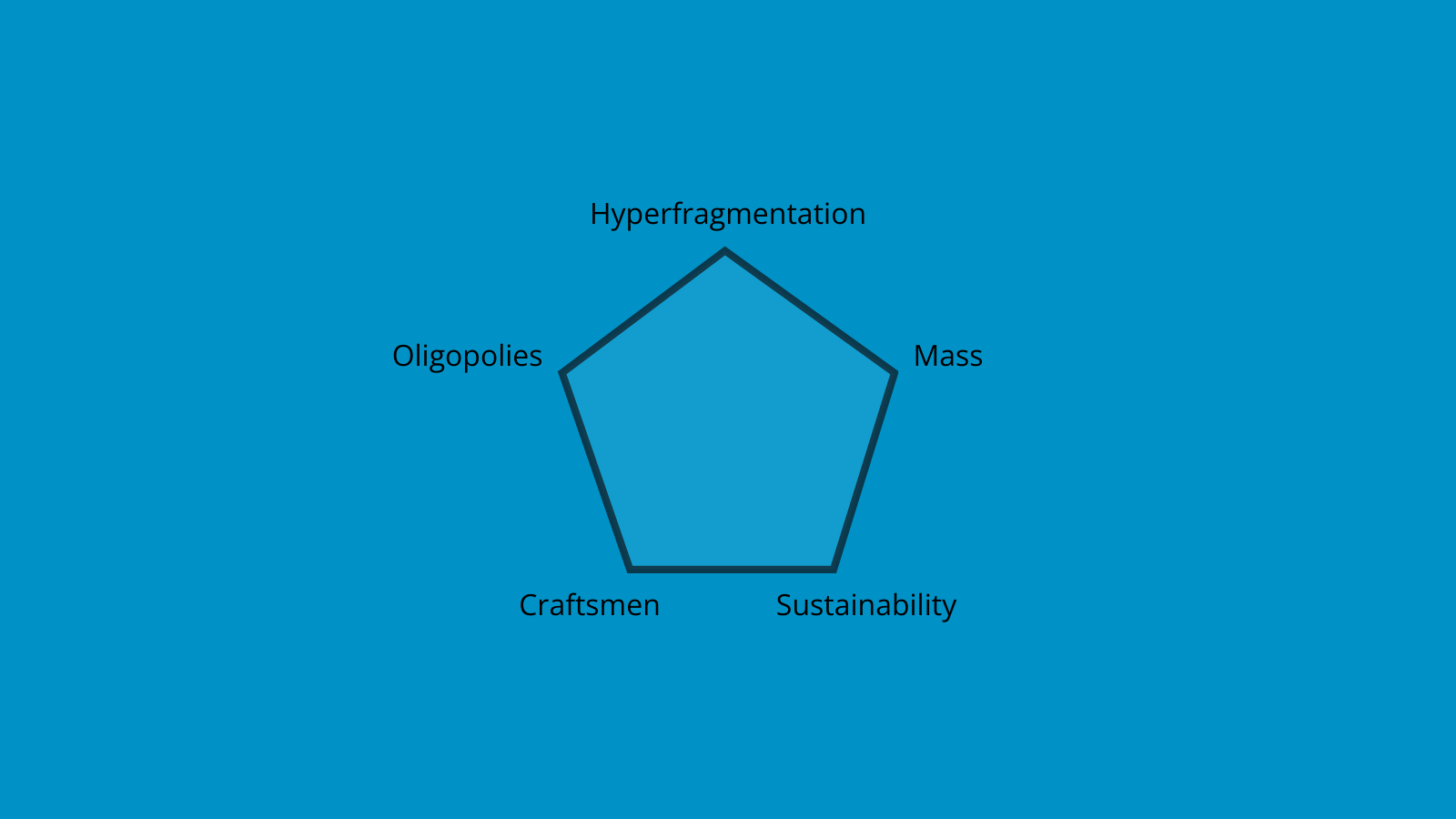
Below is a universal typology of industry clusters, which serves as a map for strategic positioning and informed decision-making in any mature market economy.
Cluster 1: Hyperfragmentation
Dynamic markets with a huge number of players serving the end consumer represent a highly competitive environment. Characteristic features include high employee and company turnover, as well as constant competition for location and customer success. In such markets, entry barriers are low, but due to severe fragmentation, average turnover per firm is low. Survival requires constant adaptation.
Cluster 2: Massiveness
Dynamic markets with a huge number of players serving the end consumer represent a highly competitive environment. Characteristic features include high employee and company turnover, as well as constant competition for the right location and every customer success. In such markets, entry barriers are low, but due to severe fragmentation and pricing pressure, average turnover per firm is low.
Cluster 3: Oligopolies
Highly concentrated markets, controlled by a small number of corporate giants with colossal turnover, are today the dominant force. Their dominant position is reinforced by high barriers to entry (capital, regulation, technology). This situation significantly limits competition and innovation.
Cluster 4: Craftsmen
Industries that value specialization and craftsmanship. Many small and medium-sized workshops compete in narrow niches. Barriers to entry are moderate, but survival requires unique skills and reputation.
Cluster 5: Stability
Mature markets are characterized by the presence of a significant number of established, often highly specialized firms. These companies have been in existence for a long time, have accumulated expertise, and have occupied their niches. Competition exists, but thanks to specialization, these companies achieve stable sizes and generate predictable profits.